
MATCH PREVIEW
PSG and Arsenal Set for Champions League Final Showdown in Budapest
Paris Saint-Germain and Arsenal meet in Budapest for a Champions League final shaped by attacking firepower, defensive control and major European history.
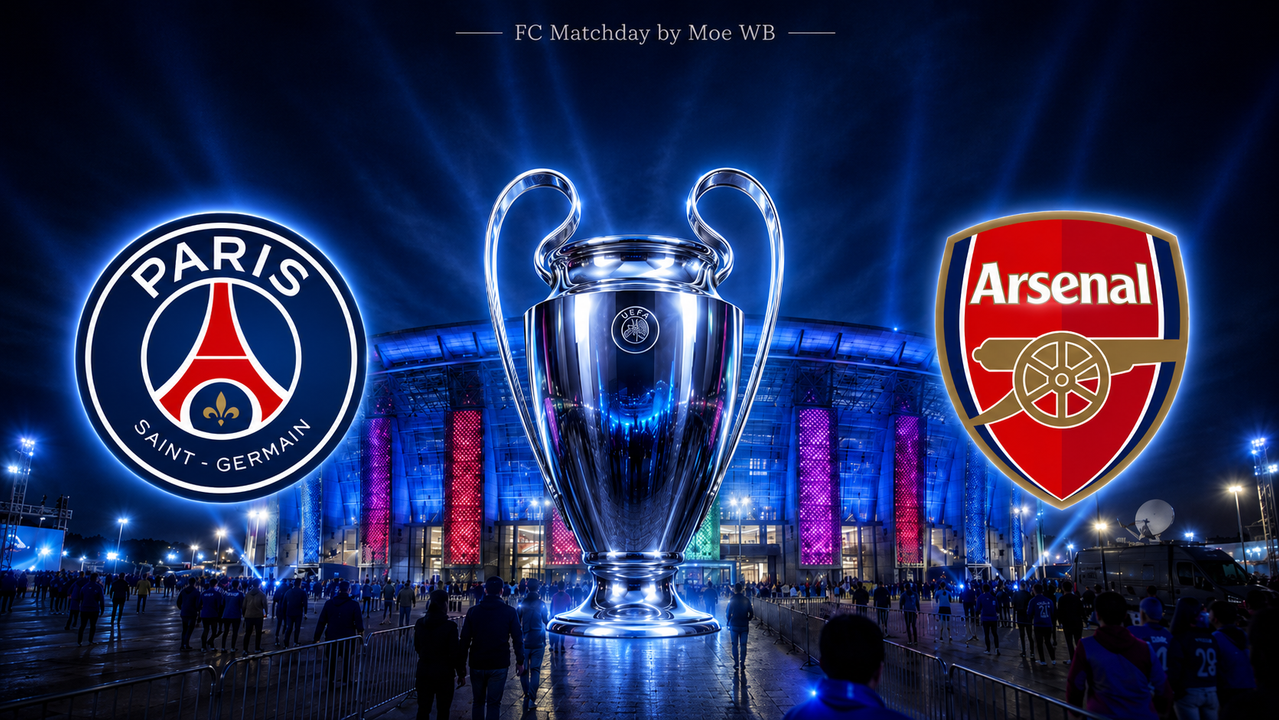
Paris Saint-Germain and Arsenal are preparing for a defining Champions League final in Budapest, where the reigning European champions face a Premier League-winning Arsenal side still unbeaten in this season’s competition. The 2025-26 final at the Puskas Arena brings together PSG’s relentless attacking output and Arsenal’s tournament-leading defensive record, creating a showpiece built on contrast, control and the pressure of history.
For PSG, the match represents a chance to confirm their new era under Luis Enrique as more than a single-season triumph. The French champions arrive as holders and are chasing the rare achievement of back-to-back European Cups, a milestone no French club has previously completed. For Arsenal, the occasion carries a different emotional weight. Twenty years after their painful defeat in the 2006 Champions League final, the Gunners have another opportunity to lift the trophy that has long escaped them.
PSG chase history after evolving beyond the superstar era
PSG’s run to Budapest has been built on a different kind of identity from the one that defined much of their modern European pursuit. Rather than leaning on one individual superstar, Luis Enrique has shaped a side around collective pressing, fluid movement and attacking depth. That approach has not always looked flawless, particularly during a league phase in which PSG collected 14 points from 24, but their knockout campaign has underlined their ability to rise when the stakes are highest.
The holders have grown stronger through the decisive rounds, eliminating Monaco, Chelsea, Liverpool and Bayern Munich on their way to the final. Their attacking numbers tell much of the story. PSG lead this season’s Champions League scoring charts with 44 goals, leaving them just one short of the competition record set by Barcelona in 1999-00. They have failed to score only once in the tournament, a goalless draw against Athletic Bilbao, and have regularly turned knockout ties into tests of endurance for opposing defences.
Luis Enrique’s side also arrive with a remarkable scoring rhythm across all competitions. Even after ending their Ligue 1 campaign with a 2-1 defeat to Paris FC, PSG extended their scoring run through Bradley Barcola’s goal. With the domestic title already secured, that final league result did little to change the broader picture: PSG enter the final as a team with proven firepower, European experience and a clear attacking structure.
Arsenal’s unbeaten campaign meets its biggest examination
Arsenal reach the final with a different kind of authority. Mikel Arteta’s side have not lost a Champions League match all season, becoming the first team to go 14 games unbeaten in a single campaign in the competition. Their defensive record has been just as impressive, with nine clean sheets, one short of the benchmark jointly associated with Arsenal’s 2005-06 side and Real Madrid’s 2015-16 campaign.
The Gunners’ route to Budapest has not always been treated with universal admiration, but their place in the final reflects the consistency that carried them through the league phase and the knockout rounds. Arsenal handled Bayer Leverkusen, Sporting Lisbon and Atletico Madrid to secure their spot in Hungary, combining discipline with the narrow-margin efficiency that has also defined their recent domestic form.
The timing gives Arsenal’s campaign added significance. Having already lifted the Premier League title, Arteta is now one match away from completing a European Cup and English top-flight double. That achievement would place this team in a select domestic lineage, while also delivering the Champions League success that Arsene Wenger never managed during his decorated spell in north London.
Key team news could shape the final
Both teams arrive with important selection questions, particularly in wide defensive areas. PSG are expected to have Ousmane Dembele available after a calf concern in the final Ligue 1 fixture. The issue was described as largely precautionary, and the forward is expected to lead the line alongside Desire Doue and Khvicha Kvaratskhelia. Nuno Mendes is also anticipated to recover from a thigh issue, while Achraf Hakimi has returned from a hamstring problem, although his place in the starting XI is not guaranteed.
That uncertainty may see Warren Zaire-Emery continue as an auxiliary right-back, while Matvey Safonov has established himself as Luis Enrique’s first-choice goalkeeper. PSG’s likely balance will depend on how much risk the coach is prepared to take with Hakimi, especially against an Arsenal side capable of attacking both flanks through pace, combination play and quick switches of possession.
Arsenal’s right-back situation is equally significant. Jurrien Timber has been dealing with a severe groin problem and has not played since before the March international break, while Ben White is absent with a knee issue. Arteta has suggested Timber is fit to start, but the final decision could carry major consequences, particularly with Kvaratskhelia expected to operate in PSG’s left-sided attacking lane.
- PSG’s major strengths are their attacking depth, scoring consistency and knockout momentum.
- Arsenal’s strongest platform is their unbeaten European run and tournament-leading defensive structure.
- The right-back decisions for both sides could strongly influence the rhythm of the final.
- The match also carries major historical stakes for Luis Enrique, Mikel Arteta and Arsenal’s pursuit of a first Champions League title.
A final of styles, pressure and legacy
The tactical headline is clear: PSG’s most productive attack in the competition meets Arsenal’s most resilient defence. Yet the final is unlikely to be decided by one simple contrast. PSG’s ability to press high, move quickly between the lines and create overloads in wide areas will test Arsenal’s composure. Arsenal, meanwhile, have the midfield structure and defensive organisation to slow the game, protect central spaces and strike through Bukayo Saka, Martin Odegaard and Viktor Gyokeres.
There is also a psychological layer. PSG know what it means to win this competition and are now playing to prove they can dominate it across multiple seasons. Arsenal are chasing release from two decades of European frustration, with the memory of 2006 still part of the club’s Champions League story. For Arteta, victory would be transformative. For Luis Enrique, another European crown would strengthen his standing among the elite managers of the modern era.
Budapest is therefore set for a final with more than one narrative. It is PSG’s chance to become a repeat champion, Arsenal’s chance to complete a historic double, and a meeting of two teams whose seasons have been built in very different ways. Whether the match is settled by PSG’s explosive front line, Arsenal’s defensive discipline or one defining moment under pressure, the 2025-26 Champions League final has the ingredients of a landmark European night.
Comments
Comments publish immediately.
Loading comments...